Manage Subawards with the Right Level of Oversight

What Every PI Should Do
Monitoring is more than approving an invoice. Check whether the subrecipient’s work, reports and spending match the agreed scope and schedule, and keep a record of what you reviewed.
Review Progress
Read required technical and financial reports. Compare results with milestones, deliverables and the statement of work.
Review Invoices
Confirm costs appear reasonable and consistent with the approved budget, period and reported progress. Raise questions before approval.
Communicate and Document
Stay in contact, record key decisions and follow up promptly on missing reports, delays or other concerns.
How to Determine Subaward Risk
Before a subaward is issued, DCG collects and reviews information about the proposed subrecipient and the work it will perform and completes a risk assessment. For subawards, this risk review helps identify if there is any heightened risk where additional monitoring by the PI might be appropriate. DCG communicates with the PI when the assigned risk level is designated as medium or high so that they are aware of any added oversight considerations.
Experience and Performance
Has the organization managed similar awards? Is it new to USC? Have its reports or deliverables arrived on time?
Audit and Financial Information
What do prior audits, available financial statements, accounting systems and internal controls show?
Project Exposure
How much of the prime award is going to the subrecipient, and how much does USC depend on its work to meet project goals?
Other Relevant Circumstances
DCG considers non-U.S. settings and sponsor requirements. For federal awards, USC also checks whether an entity is excluded from receiving funds, including through SAM.gov.
Use the Assigned Risk Level
What Changes as Risk Increases?
Depending on the risk level the PI should consider implementing different practices for ensuring appropriate monitoring of their subaward. Below are some common practices that should be implemented for subawards at different levels of risk. If a PI has a concern they can always reach out to DCG for guidance or to request the addition of terms or requirements to address any concerns.
Standard Monitoring
Low Risk
Possible Indicators
- Established organization with relevant experience.
- Strong audit history and documented controls.
- Timely reports and a straightforward scope.
Recommended PI Actions
- Review required performance reports, deliverables and invoices against the agreement.
- Hold routine progress check-ins appropriate to project milestones.
- Record the review, approvals and any follow-up questions.
- Tell DCG promptly if performance, reporting or compliance changes.
Enhanced Monitoring
Medium Risk
Possible Indicators
- New partner or limited similar-award experience.
- Past reporting delays or remediated audit findings.
- Significant budget share or more complex work.
Recommended PI Actions
- Continue all baseline reviews.
- Agree with DCG on more frequent reports or milestone check-ins, as appropriate.
- Request expenditure detail or selected supporting documents when warranted.
- Document check-ins, missed milestones and corrective follow-up.
Intensive Monitoring
High Risk
Possible Indicators
- Significant unresolved findings or weak controls.
- Repeated performance or compliance issues.
- High dependency on critical deliverables.
Recommended PI Actions
- Continue baseline and relevant enhanced reviews.
- Reach out to DCG to ensure that your monitoring plan addresses any areas of concern.
- Use more frequent reports, detailed invoice support, and virtual or on-site reviews when appropriate.
- Escalate missed milestones, questionable costs or unresolved issues immediately.
Important: A single characteristic does not automatically determine the risk tier. Risk may change when new information arises.
Risk-Based Monitoring Guide
For medium- and high-risk subawards, PIs can work with their DCG Subcontract Officer to include additional and more restrictive terms to address any areas the PI feels might require additional monitoring to ensure subcontractor compliance. In the event the PI chooses not to implement additional terms, the PI will need to ensure their monitoring plan takes any areas of concern into account.
| What to Check | Low Risk | Medium Risk | High Risk |
|---|---|---|---|
| Reports and Deliverables | Review required reports and progress against milestones. | Use more frequent or interim reports where warranted. | Agree on closer reporting and corrective milestones. |
| Invoices and Spending | Check costs against the budget, period and progress. | Review expenditure detail or selected support. | Use detailed support and heightened invoice review as directed. |
| Communication | Hold routine check-ins and record decisions. | Increase check-ins; document outcomes and follow-up. | Coordinate frequent reviews and prompt escalation. |
| Additional Oversight | Raise concerns when they arise. | Discuss a desk review or added conditions with DCG. | Consider structured review, special terms and a written monitoring plan. |
| Evidence to Retain | Reports, reviewed invoices and notes. | Baseline records plus added reviews and follow-up. | Written plan, supporting reviews, corrective actions and decisions. |
A Simple Monitoring Plan
It is not only important to ensure that appropriate monitoring is happening but also to document the checks and check-ins that have been in place. There are simple ways to do this to ensure that the PI is ready in the event there is any question as to the monitoring that took place.
Plan
Be aware of the level of risk of the subaward, required reports, milestones, invoice checks, check-in schedule and contacts.
Review
Note the date, item reviewed, finding, decision and person responsible. Keep supporting reports and communications.
Follow Up
Track a concern to resolution. Contact DCG early about delays, questionable costs, compliance or needed agreement changes.
Who Does What?
PI and Department
- Monitor technical progress and deliverables.
- Review invoices in light of progress and approved scope.
- Keep monitoring notes and relevant records.
- Create and adhere to a monitoring plan.
- Be aware of the risk level of the subaward.
- Request the addition of terms to mitigate risk.
- Flag concerns and work with DCG on next steps.
DCG Subaward Officer
- Assess subaward risk and communicate high- and medium-risk designations to the PI.
- Upon PI request, include additional terms to manage risk on high- and medium-risk subawards.
- Advise the PI on any identified risk and possible ways to mitigate risk.
- Communicate high- and medium-risk subawards to the sponsor where required.
- Assist the PI with coordinating a response to any communicated breach of subaward terms.
Tools and Resources
Below are some tools and guidance to assist you in ensuring that you have a robust plan for monitoring your subcontracts.
USC Research Administration Navigator
Use the RA Navigator by uploading the subaward, identifying any areas of risk or concern, and requesting assistance with generating a subaward monitoring plan for the PI.
Open the RA Navigator →PI Risk-Based Subaward Guidance
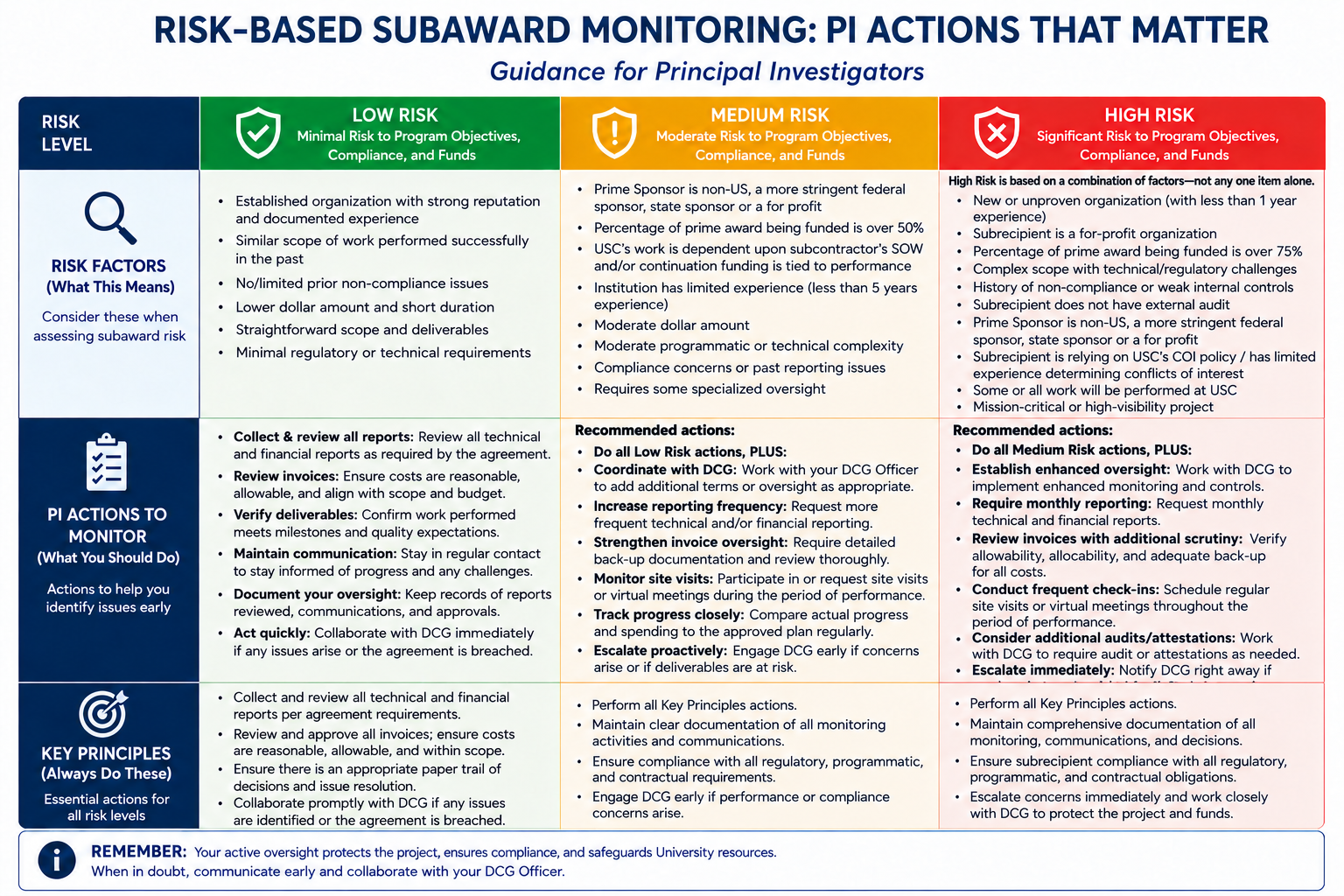
Review the complete risk-based guidance for low-, medium-, and high-risk subawards.
View or Download Guidance →Subaward Monitoring
Effective management of your outgoing subaward: a short guide for PIs and administrators.
Watch the Video →